

An hour-long meeting produces decisions, deadlines, and action items that evaporate within a day unless someone writes them down, and manual note-taking pulls that person out of the conversation. A dedicated AI voice recorder captures the audio, transcribes it, and returns a structured summary minutes after everyone leaves the room. We compared 10 devices on microphone quality and noise reduction, transcription accuracy, battery life, onboard storage, included AI minutes and subscription cost, form factor, and language support. The Turonic AI Recorder Pro L813 came out on top for its balance of 128 GB of storage, dual-mic denoising, and a $99.99 price that undercuts every rival on this list.
Best
Turonic AI Recorder Pro L813
Best Overall AI Voice Recorder for Meetings
A Year of Meetings on the Device, Transcribed in One Tap
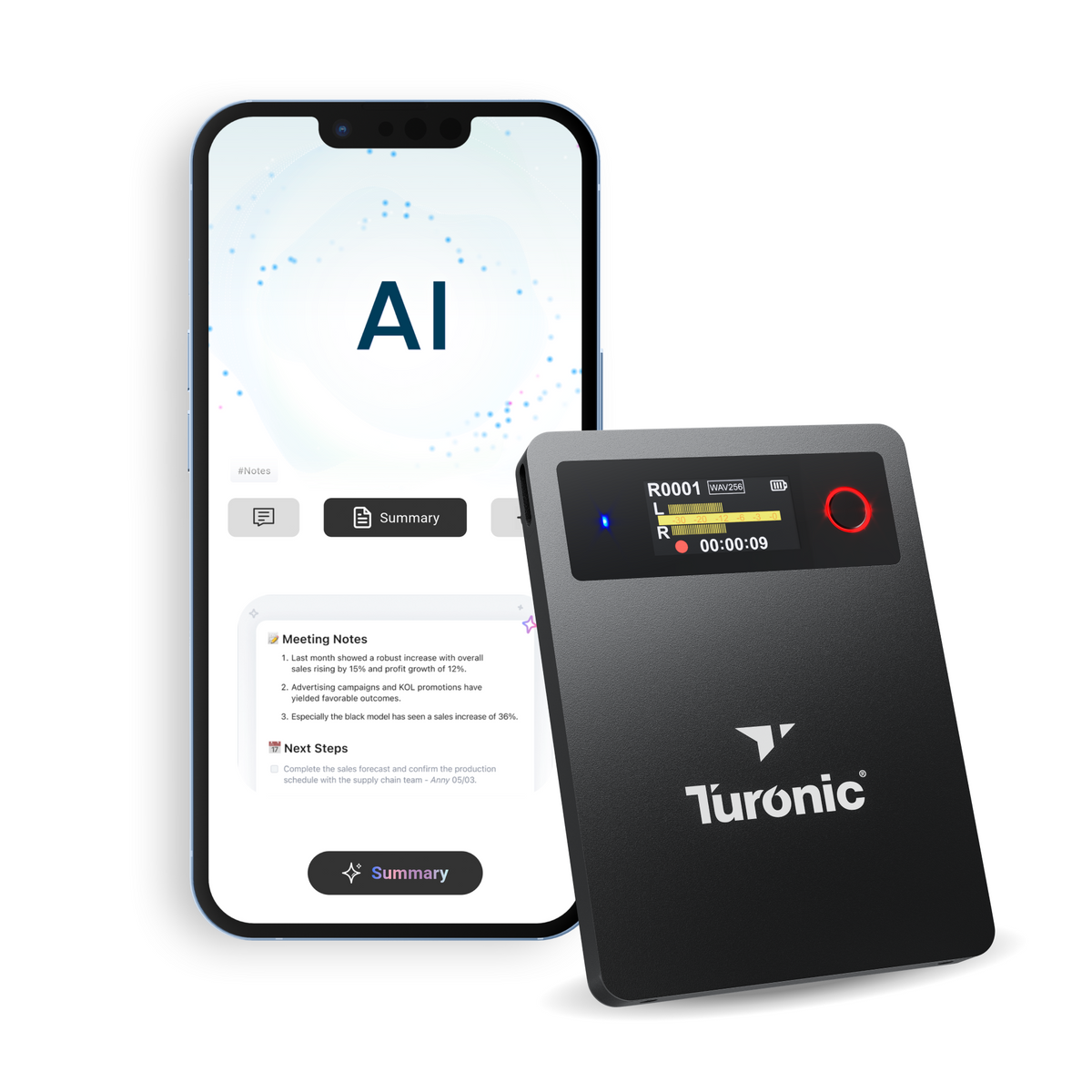
The L813 packs 128 GB of encrypted storage, double any card-style rival, so recordings stay on the device instead of forcing constant offloading. Dual omnidirectional microphones with an active denoising filter strip keyboard taps and HVAC hum before the audio reaches transcription, and one button turns any recording into a raw transcript, an executive summary, or a mind map across 30+ languages. File-level password protection keeps sensitive client conversations locked down.
Full Conference Day of Battery at the Lowest Price in Class
A 750 mAh battery covers a full conference day per charge, and the 800-minute monthly AI allowance for the first year handles roughly four meetings a day, more than double the 300-minute industry standard. The magnet ring mounts it hands-free to a laptop or whiteboard, and Bluetooth plus USB-C move files either way. At $99.99, it undercuts competitors with half the storage by $50 to $90.
What Makes an AI Voice Recorder Good for Meetings?

An AI voice recorder pairs dedicated recording hardware with a transcription and summarization engine, so a raw audio file turns into searchable text, action items, and summaries without manual replay. A traditional voice recorder stops at the audio file: one long WAV, zero structure, and an hour of scrubbing to find who agreed to what.
Meetings punish weak hardware in specific ways. Several people speak from different distances and angles, voices overlap, and HVAC hum, keyboard clatter, and hallway noise sit under everything. A single phone mic pointed at one speaker misses half the room and feeds the transcription engine muddy input, which drops accuracy exactly on the fragments that matter, such as numbers, names, and deadlines. Meeting-grade devices counter this with multi-microphone arrays (omnidirectional or beamforming), active noise reduction, and pickup ranges of 3 to 15 meters, so the transcript stays clean even from the far end of a conference table.
Three device categories compete for this job, each suited to different situations. Dedicated hardware recorders (card-style magnetic devices, pocket recorders, wearable clips) start with one button press, run on their own battery, and keep recordings independent from your phone. Phone apps cost nothing upfront but drain the phone battery within four to five hours, stop when a call comes in, and require unlocking the screen mid-conversation. Bot-based meeting software (Otter, Fireflies, and similar tools) joins Zoom or Teams calls as a participant and handles online meetings well, yet it captures nothing in a physical room. For anyone who sits in both boardrooms and on video calls, dedicated hardware covers a wider range, and several devices on this list record online meetings via call-mode switches or desktop companions.
Within dedicated hardware, watch for two disqualifiers. Devices with tiny onboard storage force constant offloading, which becomes a real constraint at 8 GB and below during travel weeks. And devices built primarily for translation rather than transcription handle multilingual conversations well but produce thinner meeting summaries, so they earn a place only in cross-language teams.
Comparison Table

|
Model |
Form Factor |
Storage |
Battery Life |
Real-Time Transcription |
Free AI Minutes / Plan |
Price |
|
Turonic AI Recorder Pro L813 |
PR |
128 GB |
Full conference day (750 mAh) |
No (one-tap post-recording) |
800 min/mo, first 12 months |
$99.99 |
|
Open Vision Engineering Pocket |
CM |
64 GB |
Up to 4 days |
No (instant post-recording) |
Core AI features included, no mandatory subscription |
$129 |
|
Plaud Note Pro |
CM |
64 GB |
30 h (50 h Endurance mode) |
No (processed after upload) |
300 min/mo |
$179 |
|
Mobvoi TicNote |
CM |
64 GB |
25 h |
Yes (17 languages live) |
600 min/mo |
$159.99 |
|
Soundcore Work by Anker |
WC |
8 GB |
8 h (32 h with charging case) |
No (cloud post-processing) |
300 min/mo |
$159.99 |
|
Comulytic Note Pro |
CM |
64 GB |
45 h |
No (post-recording) |
Unlimited transcription, lifetime Starter plan |
$159 |
|
UMEVO Note Plus |
CM |
64 GB |
40 h |
Yes (via app, year-1 plan) |
Unlimited year 1, then 400 min/mo |
$149 |
|
ABVPO Note Pro |
PR |
64 GB |
30–35 h |
No (app processing) |
Unlimited premium, first 12 months |
≈$90 |
|
iFLYTEK VOITER SR302 Pro |
CH |
32 GB |
Up to 20 h recording |
Yes (offline, 5 languages) |
Offline transcription free, no subscription |
≈$250 (import) |
|
InnAIO AI Translator T10 |
WC |
App-based (no onboard audio storage) |
15 h |
Yes (live translation subtitles) |
180-day included service, then from $100/yr |
$159 |
Legend: PR = pocket recorder with screen · CM = card-style magnetic recorder · WC = wearable clip-on / magnetic puck · CH = classic handheld recorder
Top 10 AI Voice Recorders for Meetings (Reviewed)
Every device below went through the same evaluation: verified specs from official pages, cross-checked against independent reviews, and judged on how it performs in a multi-speaker room rather than a quiet desk test. Prices reflect official store listings as of publication.
Turonic AI Recorder Pro L813 – Best Overall AI Voice Recorder for Meetings

Rating: ⭐⭐⭐⭐⭐
The L813 packs 128 GB of encrypted storage into a 52.7-gram aluminum body, double the capacity of any card-style rival. Dual omnidirectional mics with an active denoising filter out keyboard taps and HVAC hum before the audio reaches transcription. One button converts a recording into a raw transcript, an executive summary, or a mind map, and the first year includes 800 free AI minutes per month.
Detailed Specifications:
- Form Factor: Pocket recorder with 0.98" TFT color screen
- Storage: 128 GB internal, encrypted
- Recording Time (max): Up to 1,165 h to storage
- Battery: 750 mAh, full conference day per charge
- Microphones: Dual omnidirectional with denoising
- Real-Time Transcription: No, one-tap post-recording
- Languages Supported: 30+
- Connectivity: Bluetooth + USB-C
- Weight: 52.7 g
- Price: $99.99
+ Pros:
- 128 GB, largest in class
- 800 free AI min/month, year one
- Lowest price in this roundup
- Dual-mic active noise canceling
- File-level password protection
- Magnet ring for hands-free mounting
- Color screen, one-tap controls
- Cons:
- No live transcription during meetings
- Language support (30+) well below rivals' 112–152
- Bluetooth transfer slower than Wi-Fi sync
Why it's our choice for meetings:
A full year of recordings fits on the device without offloading; the 800-minute monthly allowance covers roughly four meetings a day; and the $99.99 price is $50 to $90 below competitors with half the storage. The denoise pipeline keeps conference-room transcripts clean.
Open Vision Engineering Pocket

Rating: ⭐⭐⭐⭐☆
Pocket is a screenless card that snaps onto a phone via MagSafe, separating recording from the smartphone entirely. Dual studio mics handle room audio, a contact mic handles phone calls, and the app returns transcripts, summaries, action items, and mind maps in 120+ languages. Core AI features are available without a mandatory subscription, which keeps long-term costs predictable.
Detailed Specifications:
- Form Factor: Card-style magnetic (MagSafe), screenless
- Storage: 64 GB + unlimited cloud
- Recording Time (max): Up to 96 h per charge
- Battery: Up to 4 days
- Microphones: Dual studio + contact mic for calls
- Real-Time Transcription: No, instant post-recording
- Languages Supported: 120+
- Connectivity: Bluetooth, magnetic charging
- Weight: 52 g
- Price: $129
+ Pros:
- 4-day battery, class-leading endurance
- No mandatory subscription
- Dedicated call-recording switch
- AI model choice for processing
- Speaker separation in transcripts
- Encryption with HIPAA compliance claims
- Cons:
- Weak fit for Zoom/Teams calls
- Accuracy drops in loud rooms
- Young brand, maturing support
- Needs phone nearby to sync
Why it's our choice for meetings:
Four days of battery life survive conference weeks when charging slips through the cracks, and the subscription-free core plan suits teams that record heavily. In-person meetings and phone calls are its home turf; video-call-first workflows should look elsewhere in this list.
Plaud Note Pro AI Voice Recorder

Rating: ⭐⭐⭐⭐☆
Plaud's flagship holds the #1 spot in Amazon's Digital Voice Recorders category. Four MEMS mics plus a VPU sensor with AI beamforming pull clear voice from 16.4 feet, the widest verified pickup among card recorders here. An AMOLED strip shows recording status, and Plaud Intelligence produces summaries from 10,000+ templates. SOC 2, HIPAA, and GDPR compliance suit regulated industries.
Detailed Specifications:
- Form Factor: Card-style magnetic with AMOLED display
- Storage: 64 GB (about 480 h)
- Recording Time (max): 30 h Enhance / 50 h Endurance mode
- Battery: 500 mAh, 60-day standby
- Microphones: 4 MEMS + 1 VPU, beamforming
- Real-Time Transcription: No, processed after upload
- Languages Supported: 112
- Connectivity: BLE 5.4 + dual-band Wi-Fi
- Weight: 30 g
- Price: $179
+ Pros:
- 16.4 ft pickup range, class-leading
- 4-mic beamforming array
- SOC 2, HIPAA, GDPR compliant
- AMOLED status display
- Smart dual-mode auto-switching
- 10,000+ summary templates
- Cons:
- 300 free min/month runs out fast
- Proprietary magnetic charging cable
- Highest price among card recorders
- Cloud-only processing, no on-premise option
Why it's our choice for meetings:
The 5-meter beamforming pickup earns its keep in large conference rooms where cheaper dual-mic devices lose the far end of the table. Compliance certifications make it the safe pick for legal, healthcare, and finance teams that record client conversations.
Mobvoi TicNote AI Voice Recorder

Rating: ⭐⭐⭐⭐☆
TicNote runs live transcription in 17 languages while the meeting is still happening, a feature most card rivals skip. A hardware slider switches between call mode (vibration-conduction sensor) and meeting mode (3-mic array, 10 m pickup, 1536 kbps). The Shadow AI assistant builds summaries, mind maps, and deep research reports on the GPT-5, Claude, and Gemini backends, with 600 free minutes per month.
Detailed Specifications:
- Form Factor: Card-style magnetic with 0.42" OLED
- Storage: 64 GB (434 h) + unlimited cloud
- Recording Time (max): 25 h per charge
- Battery: 470 mAh, 20+ days standby
- Microphones: 3-mic array (2 MEMS + vibration sensor)
- Real-Time Transcription: Yes, 17 languages live
- Languages Supported: 120+ post-recording
- Connectivity: Wi-Fi sync + magnetic Type-C
- Weight: 29 g
- Price: $159.99
+ Pros:
- Live transcription during meetings
- 600 free AI min/month
- Photo notes sync to transcript
- Multi-LLM backend (GPT-5, Claude, Gemini)
- Wi-Fi file sync, fast
- Unrestricted export formats
- Cons:
- 25 h battery trails Comulytic/UMEVO
- Advanced outputs need cloud connection
- Pro plan required for heavy use
- Live mode drains battery faster
Why it's our choice for meetings:
Watching the transcript form live lets you verify quotes and decisions before anyone leaves the room, which post-processing devices simply can't do. The 600-minute free tier doubles the industry-standard 300 and covers most weekly meeting loads without a paid plan.
Soundcore Work by Anker AI Voice Recorder

Rating: ⭐⭐⭐⭐☆
Anker shrank the meeting recorder to a 10-gram coin that clips to a collar or hangs as a pendant. Dual mics feed a transcription engine with a claimed 97% accuracy, a double-tap gesture marks key moments mid-recording, and speaker identification separates up to four voices. Audio remains AES-256-encrypted on the device, and cloud copies are deleted after processing.
Detailed Specifications:
- Form Factor: Wearable coin, clip or pendant
- Storage: 8 GB (about 268 h)
- Recording Time (max): 8 h device, 32 h with charging case
- Battery: 8 h; 10-min top-up adds 2 h
- Microphones: Dual-mic, 360° pickup
- Real-Time Transcription: No, cloud post-processing
- Languages Supported: Transcription via Soundcore app (multi-language)
- Connectivity: Bluetooth, USB-C case, MFi certified
- Weight: 10 g
- Price: $159.99
+ Pros:
- 10 g, wear-and-forget size
- Double-tap highlights key moments
- AES-256 with cloud auto-deletion
- Speaker ID up to 4 voices
- Fast 10-minute top-up charging
- Anker hardware reliability
- Cons:
- 8 GB, smallest storage here
- 8 h standalone battery limits long days
- $15.99/mo Pro adds up quickly
- 300 free min/month is tight
Why it's our choice for meetings:
For back-to-back walking meetings, site visits, and hallway conversations, nothing here disappears onto clothing as a 10-gram coin does. Buyers who record more than an hour a week should budget for the Pro plan, which pushes total cost above card-style rivals.
Comulytic Note Pro

Rating: ⭐⭐⭐⭐☆
Comulytic attacks the subscription model directly: the lifetime Starter plan includes unlimited transcription and basic summaries at $0 per month. The 45-hour battery life and 107-day standby time lead the way in this roundup, and WIRED named it its Best Overall AI Notetaker for 2026. Dual MEMS mics plus a VPU capture voices within 5 meters, with a triple-model engine (Whisper, GPT, Gemini) behind processing.
Detailed Specifications:
- Form Factor: Card-style magnetic with 0.78" display
- Storage: 64 GB + cloud backup
- Recording Time (max): 45 h per charge
- Battery: 400 mAh, 107-day standby
- Microphones: 2 MEMS + 1 VPU, 5 m pickup
- Real-Time Transcription: No, post-recording
- Languages Supported: 113
- Connectivity: BLE + Wi-Fi (10× faster transfer)
- Weight: 27.6 g
- Price: $159
+ Pros:
- Unlimited free transcription, lifetime
- 45 h battery, best in class
- 107-day standby
- Wi-Fi sync 10× Bluetooth speed
- Adaptive mode auto-detection
- Frequently discounted below $130
- Cons:
- No live transcription or captions
- Call recording through case inconsistent
- Proprietary charging cable
- Newer brand, thin compliance record
Why it's our choice for meetings:
Heavy recorders who burn through 300-minute allowances in a week save $100 to $240 a year against subscription-based rivals. A week of full meeting days fits on a single charge, and the review-later workflow suits people who read summaries rather than watching live text.
UMEVO Note Plus

Rating: ⭐⭐⭐⭐☆
UMEVO bundles a year of unlimited transcription with the hardware, then drops to a permanent 400 minutes free per month, a friendlier long-term floor than most rivals. The 3 mm slim card records 40 hours per charge, flips between call and meeting modes with a physical switch, and transcribes 140 languages through a GPT-4.1 engine with a claimed 99% accuracy. SOC 2, HIPAA, and GDPR compliance is documented.
Detailed Specifications:
- Form Factor: Card-style magnetic, 3 mm thick
- Storage: 64 GB + unlimited cloud
- Recording Time (max): 40 h per charge
- Battery: 400 mAh, 60-day standby
- Microphones: Multi-mic with HD noise reduction, 10 ft range
- Real-Time Transcription: Yes, via app (year-1 plan)
- Languages Supported: 140
- Connectivity: USB-C, Bluetooth, Wi-Fi
- Weight: 30 g
- Price: $149
+ Pros:
- Unlimited transcription, full year
- 400 free min/month forever after
- 140 languages, near-widest here
- 40 h battery, 60-day standby
- SOC 2, HIPAA, GDPR compliant
- 30+ profession-specific summary templates
- Cons:
- 10 ft pickup trails Plaud Pro
- Real-time features tied to paid tier
- Brand founded 2024, short track record
- Pay-as-you-go pricing after allowance
Why it's our choice for meetings:
The year-one unlimited plan lets a team test heavy recording workflows without metering anxiety, and the 400-minute permanent floor still covers two to three meetings weekly at zero cost. Multilingual teams get 140-language coverage without the price premium of translation-first hardware.
ABVPO Note Pro

Rating: ⭐⭐⭐⭐☆
The budget pick of this roundup undercuts most rivals by $60 to $90 while offering 64 GB of storage, a 30- to 35-hour battery life, and a year of unlimited premium transcription through the DOWAY app. The unusual dual-mic setup pairs a MEMS silicon mic with a bone-conduction-style element, and the GPT-4o engine covers 152 languages, the widest count among the ten devices here.
Detailed Specifications:
- Form Factor: Compact pocket recorder, magnetic
- Storage: 64 GB (500+ h)
- Recording Time (max): 30–35 h per charge
- Battery: Up to 166-day standby
- Microphones: Dual (MEMS + bone conduction type)
- Real-Time Transcription: No, app processing
- Languages Supported: 152
- Connectivity: Bluetooth 5.3, magnetic charging
- Weight: N/A (not published)
- Price: ≈$90
+ Pros:
- Lowest price after Turonic
- 152 languages, widest coverage
- 1-year unlimited premium included
- 90%+ background noise suppression claim
- 166-day standby
- AES-256 encrypted cloud sync
- Cons:
- 200-file directory limit
- Poorly translated setup instructions
- DOWAY app less polished
- Unknown brand, limited support history
Why it's our choice for meetings:
Teams equipping several people at once can buy three ABVPO units for the price of one Plaud Note Pro and still get a year of unlimited transcription on each. Software's rough edges are the trade; the recording hardware itself performs above its price point.
iFLYTEK VOITER SR302 Pro

Rating: ⭐⭐⭐⭐☆
The SR302 Pro solves a problem every other device here shares: dependence on cloud processing. Its 8-core processor transcribes fully offline, in real time, with no network, no subscription, and no audio leaving the device. Two 10 mm directional mics reach 15 meters, and four omnidirectional mics cover 360°, the most serious microphone hardware in this roundup, built by a speech-recognition company with two decades in the field.
Detailed Specifications:
- Form Factor: Classic handheld recorder
- Storage: 32 GB
- Recording Time (max): Up to 20 h per charge
- Battery: Rated for full-day sessions
- Microphones: 2× 10 mm directional + 4 omnidirectional, 15 m range
- Real-Time Transcription: Yes, fully offline
- Languages Supported: 5 (CN, EN, JP, KR, RU)
- Connectivity: Wi-Fi, Bluetooth, USB
- Weight: N/A (not published)
- Price: ≈$250 (import)
+ Pros:
- Offline transcription, zero cloud
- No subscription, ever
- 15 m directional pickup
- 6-microphone array
- CCRC security certified
- Transcribes on planes, secure sites
- Cons:
- 5 languages only
- Import-channel pricing near $250
- Bulkier than card recorders
- No AI summaries or mind maps
- English UI support varies by unit
Why it's our choice for meetings:
Organizations that prohibit cloud audio processing (defense, legal discovery, secure facilities) receive real-time transcripts with no audio transmitted anywhere. The 15-meter pickup also covers lecture halls and town-hall rooms where card-sized devices lose the back rows.
InnAIO AI Translator T10

Rating: ⭐⭐⭐⭐☆
The T10 targets one specific meeting type: the multilingual one. This 30-gram magnetic puck delivers two-way translation across 140+ languages with 0.5-second latency, clones your voice from a 30-second sample so translations sound like you, and pipes live subtitles to the phone screen. A Meeting Minutes mode records conversations and builds summaries and mind maps, though its transcription depth trails that of dedicated recorders.
Detailed Specifications:
- Form Factor: Magnetic puck (Ø57 mm × 5.6 mm), MagSafe
- Storage: App-based, no onboard audio storage
- Recording Time (max): Session-based via app
- Battery: 60 mAh, 15 h use, 100-day standby
- Microphones: Built-in mic with phone-speaker broadcast
- Real-Time Transcription: Yes, live translation subtitles
- Languages Supported: 140+
- Connectivity: Bluetooth 5.4, USB-C
- Weight: 30 g
- Price: $159
+ Pros:
- 0.5 s translation latency
- Voice cloning in 140+ languages
- Live subtitles on phone screen
- Cross-app translation (WhatsApp, WeChat)
- Group chat via QR code
- 5.6 mm thin, MagSafe mount
- Cons:
- 180-day plan, then $100+/yr
- App localization rough, mixed-language UI
- Aggressive auto-shutoff after idle minutes
- Meeting summaries thinner than dedicated recorders
- No onboard storage
Why it's our choice for meetings:
Cross-border teams get something no other device here offers: both sides of a negotiation hearing each other in their own language, in the speaker's own voice, half a second behind. Buy it as a translator that records, though; monolingual teams get more from any card recorder above.
How to Choose an AI Voice Recorder for Meetings

Microphone hardware decides everything downstream, so start there. The five criteria below are ordered by how much each one affects the quality of the notes you end up with.
Start with the Microphone Array
Transcription engines can't recover words the mics never captured cleanly. For solo calls and small rooms, dual mics with noise reduction suffice; for conference tables seating six or more, look for beamforming arrays with 5 m+ pickup, such as the Plaud Note Pro's 4-mic setup or the SR302 Pro's six-microphone system. Wearable coin formats trade pickup range for portability, which works for one-on-one conversations and fails at the far end of a boardroom.
Match the Device to Your Meeting Mix
In-person meetings, phone calls, and Zoom calls place different demands on hardware. Card recorders with call-mode switches (TicNote, Comulytic, UMEVO) capture phone conversations via vibration sensors, whereas online meetings require either a desktop companion app or a device placed near the laptop's speaker. Count your typical week before buying: a video-call-heavy schedule may need software support that some hardware-first devices skip.
Check Speaker Separation and Accuracy Claims
A transcript that merges four voices into a single text block loses track of who committed to what, which defeats the point of recording. Look for documented speaker identification and treat accuracy claims above 97% as marketing until independent reviews confirm them in noisy conditions. Accuracy drops with cross-talk, accents, and background noise, so devices tested in real rooms outrank spec-sheet promises.
Calculate Total Cost, Not Sticker Price
A $90 device with a $16 monthly plan costs more over two years than a $160 device with unlimited free transcription. Add the hardware price to 24 months of the plan you'd realistically need, then compare. Free allowances range from 300 minutes monthly (Plaud, Soundcore) to 800 (Turonic, first year) to unlimited (Comulytic lifetime, UMEVO year one), and that spread can add hundreds of dollars to the total.
Verify Privacy, Encryption, and Consent Rules
Recording laws vary: some US states require all-party consent, and client conversations in legal, medical, or financial contexts add industry rules on top. Announce the recording at the start of every meeting regardless of jurisdiction. On the device side, check where audio is stored, whether it's encrypted in transit and at rest, whether your content trains AI models, and whether you can delete files on demand; regulated teams should shortlist devices with documented SOC 2, HIPAA, or GDPR compliance, or go fully offline with the SR302 Pro.
Budget shapes the shortlist last. Under $100, the Turonic L813 and ABVPO Note Pro deliver full transcription pipelines with generous first-year allowances. The $130 to $160 tier adds live transcription, longer battery life, and compliance paperwork via TicNote, Comulytic, UMEVO, and Pocket. Above $175, you're paying for pickup range and enterprise certifications (Plaud Note Pro) or for offline processing (SR302 Pro), and both premiums only pay off when your meetings actually demand them.
FAQ
What is the best AI voice recorder for meetings?
The Turonic AI Recorder Pro L813 takes the top spot at $99.99, with 128 GB of encrypted storage, dual denoising mics, and 800 free AI minutes per month for the first year. The Plaud Note Pro wins for large conference rooms thanks to its 16.4 ft beamforming pickup, and the Comulytic Note Pro wins for heavy recorders who want unlimited free transcription.
Do AI voice recorders work for online meetings like Zoom and Teams?
Yes, with the right setup. Devices with desktop companions (Plaud Desktop, TicNote's ecosystem) capture online calls directly, while any recorder in this list picks up a video call played through laptop speakers, though a step below native capture in clarity. Phone calls are routed through dedicated call modes on TicNote, Comulytic, UMEVO, and Pocket.
How accurate is AI transcription in multi-speaker meetings?
Top devices reach 95 to 98% accuracy with clear speech and drop noticeably with cross-talk, heavy accents, or background noise. Speaker identification handles four to six voices reliably on premium models, so seat the device centrally and encourage one speaker at a time for the cleanest transcripts.
Do I need a subscription to use an AI voice recorder?
Recording works without any subscription on every device in this list; the plans meter AI processing. Free allowances range from 300 minutes per month (Plaud, Soundcore) to unlimited (Comulytic's lifetime Starter plan), so match the allowance to your weekly meeting hours before assuming you'll need a paid tier.
Is it legal to record meetings with an AI voice recorder?
Legal in most jurisdictions, with consent rules that vary by location. Several US states, California among them, require all-party consent for confidential conversations, so announce the recording at the start and get verbal agreement. Workplaces and regulated industries often add their own policies on top of state law.
How much storage do I need in an AI voice recorder for daily meetings?
Compressed meeting audio runs roughly 30 to 60 MB per hour, so 64 GB holds 400+ hours, months of daily meetings before offloading. The 8 GB Soundcore Work still stores about 268 hours, and the 128 GB Turonic L813 removes the question entirely with room for over 1,100 hours.
Which AI Voice Recorder for Meetings Should You Buy?
A dedicated AI voice recorder turns the weakest part of meeting culture, the follow-up, into an automatic output, and the Turonic AI Recorder Pro L813 does it at the best price-to-capability ratio of the ten devices tested. Its 128 GB of encrypted storage doubles that of every rival, the 800-minute monthly allowance covers a full-time meeting load for the first year, and at $99.99, it costs $30 to $90 less than competitors with weaker specs.
The rest of the field wins on specific needs. Pick the Plaud Note Pro for large rooms and compliance-heavy industries, the Comulytic Note Pro or UMEVO Note Plus to escape subscription fees, the Mobvoi TicNote for live on-screen transcription, the Soundcore Work for wearable discretion, the iFLYTEK SR302 Pro where cloud processing is banned, and the InnAIO T10 for multilingual negotiations. Decide by your dominant meeting type first, then the total two-year cost, and the right device will fall out of those two answers.


